



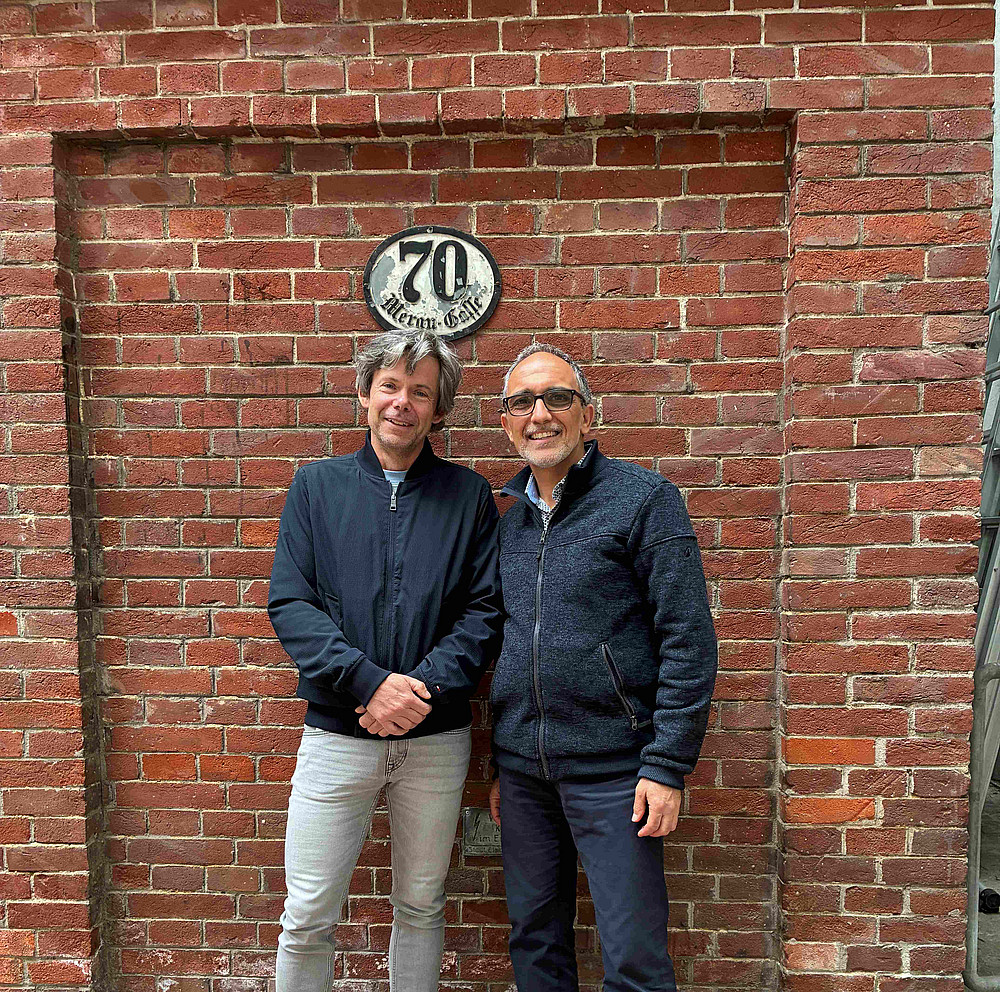
Adrian Grima
Mediterranean Maltese Literature in Graz
You could perhaps say that my engagement with the core research area of Trans-Mediterranean Entanglements started in quite a "Mediterranean" way. In my language, Maltese, we like to say that "kelma ġġib 'il oħra," that somehow "one word leads to another." It started with the inclusion of my chapter on "Elusive Mediterraneans: Reading Beyond Nation" in the prize-winning book, Sea of Literatures: Towards a Theory of Mediterranean Literature (2023), which Steffen Schneider co-edited with Angela Fabris and Albert Göschl. I found the editorial introduction insightful and when I gave a public lecture on constructing the Mediterranean imaginary at the University of Malta hosted by the Department of English in May 2025 I used it as my theoretical anchor. That led to a continuation of our discussion as co-authors of the volume about some of the main issues raised by the book. During our online conversation on the Mediterranean imaginary and Mediterraneanism, Steffen Schneider invited me to a fellowship at Graz in the context of the Research Area on Mediterranean Entanglements between 20-26 April 2026.
On Tuesday 21 April I met with Prof. Steffen Schneider and Prof. Angela Fabris from Universität Klagenfurt to discuss avenues of collaboration with the general sphere of Mediterranean studies, between myself and the Department of Maltese at the University of Malta and their respective networks.
PhD
research On Wednesday 22 April, I met with doctoral students who are doing research on different aspects of the Mediterranean. While I am particularly interested in how literature in Maltese and other languages construct the Mediterranean in quite explicit ways, as in the case of the novel N’zid by the French writer Malika Mokeddem, Les marins perdus by Jean Claude Izzo, and Cristiani di Allah by Massimo Carlotto, I was particularly interested in how the students engage with the idea of the Mediterranean as a somehow distinct cultural “entity”.
In this context we discussed their various projects, starting with Hannah Barmüller, who coordinated the meeting, about "Eco-aesthetics of Mediterranean Topographies" in 19th century French travelogues. Hannah is examining how these authors aestheticized North African and Levantine landscapes and how their texts intertwine with discourses on the environment (classical ecocriticism, material ecocriticism).
Juliana Reinisch is exploring the representation of the "Orient" and "pagans" in German medieval epic poems and her research focuses on the dynamic entanglements and cultural shifts between the Western-Christian and the Eastern-Islamic spheres. On the other hand, Hans Scherer from Archaeology is investigating the topography and history of the ancient city of Prasiai in the Peloponnese and is combining archaeological excavations and topographical research to analyzes the city's development.
Hans was keen to point out that findings on this excavation site are leading him to evaluate the context, rather than leaning on the context to evaluate the findings on site, and in a way I see this as an interesting microcosm of our engagement of the local with the regional. These are clearly issues that the students are seriously engaged with: A few days before our meeting, Hannah, Juliana and Hans organized a conference in Graz for early career researchers in Mediterranean studies.
We were also joined by Viktoria Kirchner and Pankhuri Bhatt, two researchers from the Department of Romance Studies. Dr Pankhuri Bhatt, who completed her doctorate in March, wrote a thesis that examines the accounts of French travelers on pilgrimages to the sources of the Ganges, offering an eco-critical and eco-poetic analysis of their experiences with nature. Viktoria Kirchner is a pre-doctoral researcher in Spanish Literary Studies whoe work focuses on the representation of temporality within Spanish Conquista narratives.
Negotiating the Mediterranean Imaginary
On Thursday 24 April I gave a talk to colleagues and doctoral students within Trans-Mediterranean Entanglements on “Negotiating the Mediterranean Imaginary: A Planetary Reading of Omar N'Shea's Es Sidr.“ I examined the representations of the Mediterranean in N’Shea’s book-length personal essay (Aphroconfuso, 2025) against the background of the editorial introduction to Dictionnaire de la Méditerranée (Actes Sud, 2016) and more importantly taking into consideration the planetary dimension as elaborated by Dipesh Chakrabarty in The Climate of History in a Planetary Age (2021) to explore hidden dimensions of the text’s “offstage” geography where now-time slips into deep time. In the discussion after the talk, it was this planetary reading that attracted most of the attention.
On Friday 25 April, Dr Theresa Zammit Lupi, who carried out conservation of the older document of Maltese literature, the Cantilena, written around the middle of the 15th century, gave me a detailed tour of the Department of Conservation within the Library of Universität Graz, focusing both on the work carried out by her team and possible collaboration with the Department of Maltese.
After my fellowship, I look forward, both a researcher of Mediterranean imaginaries and as head of the Department of Maltese, to further collaboration with the Core Research Area Trans-Mediterranean Entanglements and with Universität Graz in general.
Claudia Luchetti
My collaboration with the core research area Transmediterranean Entanglements gave me the opportunity to focus on a research project on Plato's use of maritime metaphors in his dialogues to describe his master Socrates.
This research, which took the form of a lecture at the Institute of Antiquity entitled Sokrates im Spiegel des Mittelmeers. Maritime Metaphors and their Levels of Meaning in Plato's Reception (or Image) of Socrates, enabled me not only to deepen my understanding of the philosophical significance of these maritime metaphors, but also to understand Plato's intention to convey to his readers the image of a "Mediterranean" philosopher, in whom Athenian urbanity and cosmopolitanism are harmoniously united, and thus also to contribute decisively to the formation of a mental image or idea of the Mediterranean.

My participation in the Focus Plenary in conjunction with the Get Together, which was aimed at the three core research areas of the faculty of humanities, allowed me to broaden my research horizon in an interdisciplinary direction and weave the threads of a collaboration that I hope will deepen over time.

Hanni Geiger
In December 2024 I was granted a fellowship at the University of Graz in the Mediterranean in the Global cluster, which is part of the Trans-Mediterranean Entanglements – Mobilities and Relations in the Mediterranean and beyond core research area.
The core research area aims at enriching international research on the Mediterranean from a decidedly transdisciplinary humanistic perspective. A fellowship programme was introduced to support the development of new concepts and methods for researching the Mediterranean, favouring a more complex understanding that builds on ambivalences and contradictions.
The cluster looks at the Mediterranean in its global context. My project On a detour. Visual arts, tourism and Adriatic complexities takes up this perspective and understands this appendage of the Mediterranean as a laboratory of globalisation processes and recognises its pivotal role in building knowledge on the world.
The fellowship entailed presenting my project with a view to the cluster’s focus. I introduced Adriatic complexities as the artistically visualised simultaneity and interrelatedness of entanglements and disentanglements between the Adriatic littoral and the global force of tourism. I showed that design, architecture, art and crafts from the 1950s onwards can reveal tensions between the global and the local that commercial images often conceal. The case studies refer to interruptions, absences and invisibilities that go hand in hand with the attractions that tourism promotes. By looking at the arts, the project takes a detour around the stereotypical fantasy of a naturally and socially flawless ‘destination Adriatic’ and towards an Adriatic characterised by material tensions. The project fosters a nuanced understanding of the Adriatic and suggests rethinking the whole Mediterranean and other maritime regions in the world that build upon tourism. It challenges simplistic narratives of globalisation that rely on fluid entanglements while advancing a non-hegemonic history of art and design.
In a discussion session, the speakers of the core topic introduced their projects, and we discussed potential complementarities in the methodologies to be applied. The interdisciplinary dialogue has proven fruitful in reflecting on how to approach and examine the Mediterranean at an early stage of the core topic’s research. The arts were deemed particularly significant for alternative understandings on the basin characterised by paradoxes and ambivalences. The fellowship has enriched my research, just as my research has enriched the research conducted in this core topic. My project benefits from the discourses and findings on the trans-Mediterranean entanglements and the role of the Mediterranean in a global context from a variety of disciplinary sources and methods. I appreciate the openness to alternative approaches, especially in the arts. They illuminate and problematise the effects of globalisation fuelled by tourism beyond fixed structures and ‘objective’ data in that they reflect often invisible or obfuscated tensions between the global and the local on the Adriatic coast.
The interdisciplinarity at the cluster complements my art-historical perspective on Adriatic connections and their disturbances as reflected in arts and design. For my part, I bring visual arts, tourism and the underexposed modern Adriatic region as a site of complex globalisation processes into the Mediterranean discourse in Graz. I integrate the concept and methodologies of Adriatic complexities into the centre’s alternative epistemologies. From a forgotten branch of the basin and by means of the arts, my findings on the Adriatic add value to the nuanced understanding of the Mediterranean’s relations to the world evidenced in the research of the core research area.
Fellowship Sophia Mehrbrey
From 27 October to 9 November 2024, I was a guest fellow at the "Mediterranean Topographies" cluster of the Trans-Mediterranean Entanglements core research area at the University of Graz. As a prelude to the fellowship, I gave a guest lecture to the members of the cluster on my habilitation project on World War II narratives in the Alpine region, the theoretical basis of which is the poetic linking of literary spatial categories and strategies of memory work. We then had the opportunity to discuss basic theoretical concepts such as topography, cartography and connectivity, and also to consider continuities and divergences between the Alpine and Mediterranean regions.

The exchange with the doctoral students from the specialisation area was particularly enriching, as I was able to discuss their doctoral projects, the theoretical foundations of our research and also the opportunities and challenges of a career as a junior researcher in two peer-to-peer meetings.
During my two-week stay, I also had the opportunity to deepen my own research project. I gained valuable ideas and new perspectives on my research through a variety of discussions with colleagues from Romance Studies and other departments. The pleasant working atmosphere at the Institute of Romance Studies enabled me to use the two weeks intensively for my habilitation.
My stay ended with the internal conference of the core research area, where I gained a deeper insight into the individual research projects of the different clusters. The joint discussions and the concluding roundtable offered the opportunity to reflect on the diversity of thematic perspectives and theoretical positions in the field of trans-Mediterranean entanglements.