



Begin of page section:
Page sections:

  • Go to contents (Accesskey 1)
  • Go to position marker (Accesskey 2)
  • Go to main navigation (Accesskey 3)
  • Go to sub navigation (Accesskey 4)
  • Go to additional information (Accesskey 5)
  • Go to page settings (user/language) (Accesskey 8)
  • Go to search (Accesskey 9)

End of this page section. Go to overview of page sections

Begin of page section:
Page settings:

English en
Deutsch de
Search
Login

End of this page section. Go to overview of page sections

Begin of page section:
Search:

Search for details about Uni Graz
Close

End of this page section. Go to overview of page sections


Search

Begin of page section:
Main navigation:

Page navigation:

  • University

    University
    • About the University
    • Organisation
    • Strategy and Quality
    • Faculties
    • Library
    • Working at University of Graz
    • Campus
    Developing solutions for the world of tomorrow - that is our mission. Our students and our researchers take on the great challenges of society and carry the knowledge out.
  • Research Profile

    Research Profile
    • Our Expertise
    • Research Questions
    • Research Portal
    • Promoting Research
    • Research Transfer
    • Ethics in Research
    • Commission for Scientific Integrity
    Scientific excellence and the courage to break new ground. Research at the University of Graz creates the foundations for making the future worth living.
  • Studies

    Studies
    • Prospective Students
    • Students
    • Welcome Weeks for First Year Students
  • Community

    Community
    • International
    • Location
    • Research and Business
    • Alumni
    The University of Graz is a hub for international research and brings together scientists and business experts. Moreover, it fosters the exchange and cooperation in study and teaching.
Topics
  • Sustainable University
  • Researchers answer
  • Work for us
Close menu

End of this page section. Go to overview of page sections

Begin of page section:
You are here:

University of Graz Trans-Mediterranean Entanglements Events Long Night of Research 2026
  • About us
  • Our research
  • Doctoral Programme
  • Events
  • Contact
  • News

End of this page section. Go to overview of page sections

Begin of page section:
Sub navigation:

  • About us
  • Our research
  • Doctoral Programme
  • Events
  • Contact
  • News

End of this page section. Go to overview of page sections

Long Night of Research 2026

This year, at the Long Night of Research on 24 April 2026, the GEWI priority areas’ stand focused primarily on the priority area of multilingualism, migration and cultural transformation. In designing the stand, we focused on the element that connects us as human beings, regardless of our background or cultural heritage: language. 

At the stand, visitors could learn interesting facts about different languages and test their knowledge straight away in a language quiz. Another popular activity was going on a language hunt. The task was to find ‘your’ pre-selected language amongst around 7,000 possibilities on the world map simulation within two minutes. 

However, our stand offered the chance to explore not only the world but also the immediate linguistic environment. Here, too, map simulations were used to locate and listen to major national languages such as Ukrainian and Belarusian, as well as smaller, lesser-known languages and varieties such as Carinthian Slovenian, Burgenland Croatian, Judeo-Spanish, Romani and Pannonian Russian. 

Many languages have regional variants. German is no exception. So, on our site, visitors could listen to various dialects spoken in Austria and try to pinpoint their geographical origin.

Many people today are multilingual, meaning they speak more than one language, sometimes from an early age. We also heard how authors sometimes deal with this diversity. The selection featured texts by Austrian authors who write not only in German, but also in their first language, in a dialect, or in multiple languages altogether. In many discussions with visitors, we explored how we engage with such texts and how society perceives multilingualism. 

We see multilingualism as a resource. The aim of the evening was therefore to paint a colourful picture of multilingualism. To this end, every visitor was invited to write a greeting in a language or dialect they were familiar with and pin it to our noticeboard. The result is just as colourful as the linguistic landscape of our world.
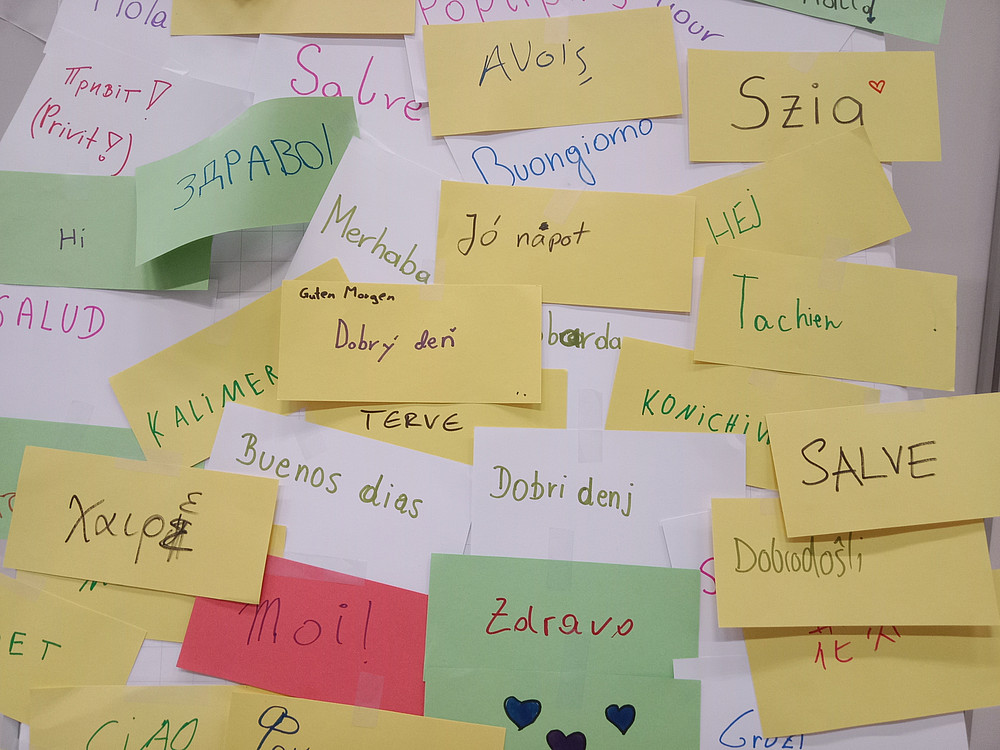
colourful little pieces of paper with writing on them ©Julia Eulenstein
©Julia Eulenstein

Begin of page section:
Additional information:

University of Graz
Universitaetsplatz 3
8010 Graz
Austria
  • Contact
  • Web Editors
  • Moodle
  • UNIGRAZonline
  • Imprint
  • Data Protection Declaration
  • Accessibility Declaration
Weatherstation
Uni Graz
University of Graz part of Arqus.

End of this page section. Go to overview of page sections

End of this page section. Go to overview of page sections

Begin of page section:

End of this page section. Go to overview of page sections